
Biostatistics in Public Health: Understanding Data for Better Health Decisions
Every day, public health professionals make decisions that affect millions of lives. Whether it is monitoring the spread of infectious diseases, evaluating vaccination programs, identifying health risks, or measuring the impact of public health interventions, these decisions must be based on reliable evidence rather than assumptions. This is where biostatistics plays a fundamental role in public health.
From understanding disease trends to evaluating the effectiveness of healthcare programs, biostatistics helps transform raw health data into meaningful information that supports evidence-based decision-making. Governments, healthcare organizations, researchers, and international agencies rely on statistical methods to identify health challenges, allocate resources, and develop policies that improve population health.
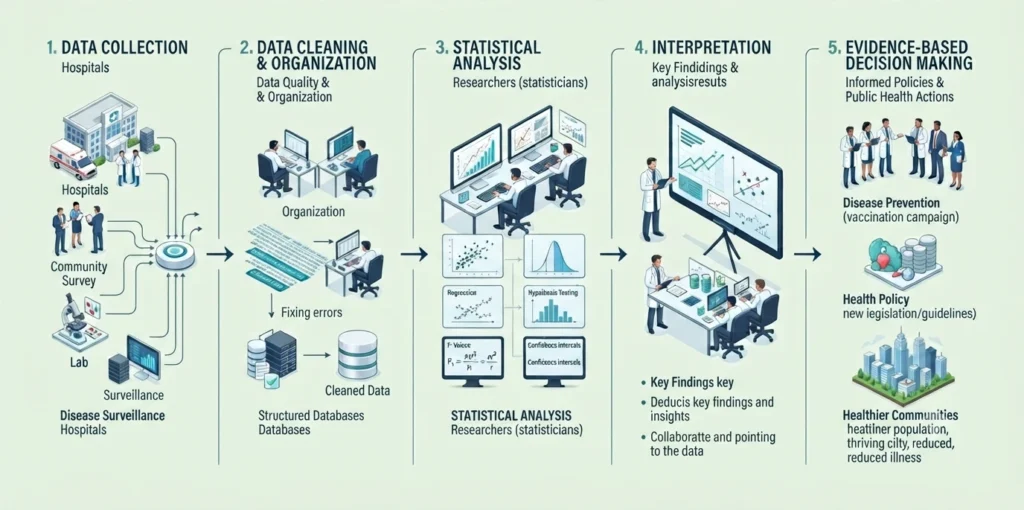
In today’s data-driven healthcare environment, public health professionals collect enormous amounts of information through disease surveillance systems, health surveys, clinical studies, hospital records, and community health programs. Without proper statistical analysis, this valuable data would provide little insight into disease patterns or healthcare outcomes. Health data analytics enables professionals to organize, analyze, and interpret this information for informed public health action.
Biostatistics also serves as the foundation of public health research, helping researchers design studies, test hypotheses, evaluate interventions, and draw scientifically valid conclusions. Whether investigating an outbreak, assessing environmental health risks, or measuring the effectiveness of a national health program, statistical methods ensure that research findings are accurate, objective, and reproducible.
For students pursuing a Master of Public Health (MPH), learning biostatistics is much more than understanding mathematical formulas. It is about developing the ability to interpret health data, critically evaluate research findings, and contribute to evidence-based healthcare policies that improve the well-being of communities.
Before exploring the principles and applications of biostatistics, it is important to understand how this discipline fits within the broader field of Public Health, where data and evidence guide strategies for disease prevention, health promotion, and population health improvement.
What Is Biostatistics?
Biostatistics is the branch of statistics that applies mathematical and statistical methods to biological, medical, and public health data. It focuses on collecting, organizing, analyzing, interpreting, and presenting health-related information to support scientific research and evidence-based decision-making.
Unlike general statistics, which can be applied across various disciplines, biostatistics is specifically designed to address healthcare and life science questions. It helps researchers determine whether a treatment is effective, identify disease risk factors, compare health outcomes among different populations, evaluate public health programs, and measure the impact of healthcare interventions.
In public health, biostatistics works closely with epidemiology. While epidemiology studies the distribution and determinants of diseases within populations, biostatistics provides the analytical tools needed to interpret epidemiological data accurately and objectively.
Today, biostatistics is used in almost every area of public health, including disease surveillance, vaccination programs, maternal and child health, environmental health, clinical trials, healthcare policy evaluation, and health services research. By converting complex datasets into meaningful evidence, biostatistics enables healthcare professionals to make informed decisions that improve population health outcomes.
Public Health Insight
Biostatistics is often called the language of evidence-based public health. It transforms health data into reliable evidence, allowing researchers, policymakers, and healthcare professionals to make informed decisions that improve disease prevention, healthcare planning, and community well-being.
Why Is Biostatistics Important in Public Health?
Public health decisions affect entire populations rather than individual patients. Whether health authorities are responding to an infectious disease outbreak, evaluating a vaccination campaign, monitoring maternal health, or planning disease prevention programs, every decision must be supported by reliable data. Biostatistics provides the scientific framework for analyzing health information and transforming it into evidence that guides effective public health action.
Without biostatistics, public health professionals would struggle to distinguish meaningful health trends from random variation. Statistical analysis enables researchers and policymakers to identify health risks, evaluate interventions, and make decisions that improve population health.
1. Supports Evidence-Based Decision-Making
Evidence-based public health relies on scientific data rather than assumptions or personal opinions. Biostatistical methods help researchers analyze health data objectively, ensuring that public health decisions are based on measurable evidence.
By examining disease patterns, treatment outcomes, and population health indicators, biostatistics helps governments and healthcare organizations develop policies that are scientifically sound and effective.
Modern health policy decisions often depend on statistical evidence generated through public health research and surveillance systems.
2. Helps Identify Disease Patterns
One of the primary objectives of public health is to understand how diseases spread within populations. Biostatistics helps researchers analyze disease incidence, prevalence, mortality rates, and risk factors to identify important health trends.
For example, statistical analysis can reveal whether cases of diabetes are increasing within a specific age group or whether seasonal changes influence the spread of vector-borne diseases.
These findings support public health surveillance systems that continuously monitor community health and detect emerging health threats.
3. Strengthens Epidemiological Research
Epidemiology and biostatistics work together as complementary disciplines. Epidemiologists investigate the causes and distribution of diseases, while biostatistics provides the analytical methods needed to interpret research findings accurately.
Whether researchers are conducting cohort studies, case-control studies, cross-sectional surveys, or randomized clinical trials, statistical analysis ensures that conclusions are supported by valid scientific evidence.
Biostatistics also helps determine whether observed associations are statistically significant or simply due to chance.
4. Evaluates Public Health Programs
Governments and health organizations invest significant resources in immunization campaigns, maternal health initiatives, nutrition programs, and disease prevention strategies. Biostatistics helps evaluate whether these programs are achieving their intended objectives.
By comparing health indicators before and after implementation, researchers can determine program effectiveness, measure health outcomes, and identify areas requiring improvement.
Evaluation studies supported by statistical analysis enable policymakers to allocate resources more efficiently and improve future public health interventions.
5. Improves Disease Prevention Strategies
Preventing disease requires a clear understanding of risk factors, vulnerable populations, and intervention outcomes. Biostatistics enables researchers to analyze large health datasets, identify populations at greater risk, and measure the effectiveness of preventive strategies.
For example, statistical analysis may demonstrate that smoking significantly increases the risk of cardiovascular disease or that vaccination programs reduce infection rates within communities.
These findings contribute directly to disease prevention planning and health promotion initiatives.
6. Supports Healthcare Research
Almost every public health research project involves some form of statistical analysis. Researchers use biostatistics to formulate hypotheses, determine sample sizes, analyze collected data, interpret research findings, and present scientifically valid conclusions.
Without appropriate statistical methods, research findings may become unreliable or misleading, reducing their value for healthcare decision-making.
Strong statistical foundations therefore improve both the quality and credibility of public health research.
7. Guides Health Resource Allocation
Public health resources are often limited, making efficient allocation essential. Biostatistical analysis helps governments identify high-risk populations, estimate disease burden, forecast healthcare needs, and prioritize health interventions.
Using statistical evidence, policymakers can determine where additional hospitals, vaccination centers, healthcare professionals, or disease control programs are most urgently needed.
This data-driven approach improves healthcare planning while maximizing the impact of available resources.
Public Health Insight
Biostatistics enables public health professionals to convert health data into actionable evidence. From identifying disease trends and evaluating health programs to supporting research and guiding policy decisions, statistical analysis forms the foundation of evidence-based public health practice.
Key Concepts in Biostatistics
Before applying statistical methods to solve public health problems, it is essential to understand the fundamental concepts of biostatistics. These concepts form the foundation for collecting reliable data, conducting meaningful analyses, and interpreting research findings accurately.
Whether evaluating disease outbreaks, conducting health surveys, or analyzing clinical trial results, public health professionals rely on these statistical principles to ensure that health decisions are supported by valid evidence.
1. Population and Sample
One of the first concepts in biostatistics is understanding the difference between a population and a sample.
A population refers to the complete group of individuals or observations that researchers want to study. For example, all adults living in India or every patient diagnosed with tuberculosis during a specific year may represent a population.
A sample is a smaller group selected from the population for research purposes. Since studying an entire population is often expensive and time-consuming, researchers collect data from representative samples and use statistical methods to draw conclusions about the larger population.
Accurate sampling improves the reliability of public health studies and reduces research bias.
2. Types of Data
Public health researchers collect different types of health information depending on the objectives of their studies. Biostatistics classifies this information into several categories that determine the appropriate analytical methods.
Qualitative (Categorical) Data
Qualitative data describe characteristics or categories rather than numerical values.
Examples include:
- Gender
- Blood Group
- Smoking Status
- Vaccination Status
- Disease Category
These variables help researchers compare different population groups and identify health patterns.
Quantitative (Numerical) Data
Quantitative data consist of measurable numerical values.
Examples include:
- Age
- Height
- Weight
- Blood Pressure
- Blood Sugar Level
- Body Mass Index (BMI)
These measurements allow researchers to calculate averages, variation, and statistical relationships between health variables.
3. Variables in Biostatistics
A variable is any characteristic that can change from one individual to another.
Public health research commonly uses different types of variables:
Independent Variable
The factor that may influence another outcome.
Example: Smoking habits may influence the development of lung disease.
Dependent Variable
The outcome that researchers measure.
Example: Incidence of lung cancer.
Confounding Variable
A third factor that may affect both the independent and dependent variables.
Example: Age may influence both smoking behavior and disease risk.
Understanding these relationships helps researchers design stronger studies and reduce bias in health research.
4. Descriptive Statistics
Descriptive statistics summarize large amounts of health data into meaningful information that is easy to understand.
Instead of examining thousands of individual observations, researchers use summary measures to describe the characteristics of a population.
Common descriptive statistics include:
- Mean
- Median
- Mode
- Range
- Percentage
- Frequency Distribution
- Standard Deviation
These measures provide a clear overview of disease patterns, demographic characteristics, and health indicators before more advanced statistical analyses are performed.
Large public health datasets generated through health data analytics often rely on descriptive statistics as the first step in understanding population health trends.
5. Inferential Statistics
While descriptive statistics summarize collected data, inferential statistics allow researchers to make conclusions about an entire population based on a representative sample.
Inferential statistical methods help answer questions such as:
- Does a vaccine significantly reduce disease risk?
- Is a new treatment more effective than an existing therapy?
- Are observed differences caused by chance or by real biological effects?
These methods support evidence-based healthcare by estimating population characteristics and evaluating scientific hypotheses.
Inferential statistics are therefore widely used in public health research and epidemiological investigations.
6. Measures of Central Tendency
Researchers often need a single value that represents an entire dataset. Measures of central tendency describe the “center” of collected health data.
Mean
The arithmetic average of all observations.
Example: Average age of patients participating in a vaccination program.
Median
The middle value after arranging observations in numerical order.
Median is especially useful when datasets contain unusually high or low values.
Mode
The value that occurs most frequently within a dataset.
For example, the most commonly reported blood group among study participants.
Selecting the appropriate measure depends on the type and distribution of the data being analyzed.
7. Measures of Dispersion
Two datasets may have the same average but very different levels of variation.
Measures of dispersion describe how widely observations are spread around the average.
Common measures include:
- Range
- Variance
- Standard Deviation
- Interquartile Range
These statistics help researchers understand consistency, variability, and uncertainty within health data.
For example, blood pressure measurements collected from different communities may have similar average values but different levels of variation, indicating differences in population health.
Public Health Insight
Every statistical analysis begins with understanding the data itself. Concepts such as populations, samples, variables, descriptive statistics, and inferential statistics provide the foundation for reliable public health research. Mastering these principles enables researchers and public health professionals to transform raw health information into meaningful evidence that supports better healthcare decisions.
Common Biostatistical Methods Used in Public Health
After understanding the basic concepts of biostatistics, the next step is learning the statistical methods that public health professionals use to analyze health data. These methods help summarize information, compare groups, identify relationships, and determine whether observed differences are meaningful or simply due to chance.
From disease surveillance and epidemiological investigations to clinical trials and health policy evaluation, biostatistical methods provide the scientific tools needed to transform health data into reliable evidence.
1. Mean (Average)
The mean is one of the most commonly used statistical measures in public health. It represents the arithmetic average of a group of observations and provides a quick summary of numerical data.
For example, researchers may calculate:
- Average age of patients with hypertension
- Mean Body Mass Index (BMI) of a study population
- Average daily hospital admissions
- Mean blood glucose level among diabetic patients
The mean is most useful when data are evenly distributed without extreme values.
2. Median
The median is the middle value in an ordered dataset. Unlike the mean, the median is less affected by unusually high or low observations.
Public health researchers often use the median when analyzing data such as:
- Household income
- Hospital waiting times
- Length of hospital stay
- Healthcare expenditure
When datasets contain outliers, the median provides a better representation of the typical value.
3. Mode
The mode is the value that appears most frequently within a dataset.
Examples include:
- Most common blood group in a population
- Most frequently reported infectious disease
- Most common age group affected during an outbreak
- Most frequently prescribed vaccine
Mode is particularly useful when working with categorical or qualitative health data.
4. Standard Deviation
Public health professionals are often interested not only in averages but also in how much the data vary.
Standard deviation measures the spread of observations around the average.
For example:
If two communities have the same average blood pressure but one community shows much greater variation, researchers may investigate additional health risk factors affecting that population.
Standard deviation helps evaluate:
- Population variability
- Consistency of measurements
- Reliability of research findings
- Distribution of health indicators
It is widely used in epidemiological studies and clinical research.
5. Probability
Probability measures the likelihood that a particular event will occur.
In public health, probability helps researchers estimate risks such as:
- Probability of developing diabetes
- Chance of disease transmission
- Risk of infection after exposure
- Likelihood of treatment success
Probability forms the basis of disease prediction models, screening programs, and preventive healthcare planning.
6. Confidence Interval
Research findings are rarely based on complete populations. Instead, researchers analyze samples and estimate population values.
A confidence interval (CI) indicates the range within which the true population value is likely to lie.
Rather than reporting a single estimate, confidence intervals show the degree of uncertainty associated with research findings.
For example, vaccine effectiveness may be reported with a 95% confidence interval, providing greater confidence in the reliability of the results.
Confidence intervals are widely used in public health research to improve the interpretation of statistical findings.
7. Hypothesis Testing
Public health researchers frequently test whether observed differences between groups are statistically significant.
Hypothesis testing helps answer questions such as:
- Does a new vaccine reduce infection rates?
- Is air pollution associated with respiratory disease?
- Does a nutrition program improve child growth?
Statistical tests determine whether the observed results are likely due to real differences or random variation.
These methods strengthen evidence-based healthcare by supporting objective scientific conclusions.
8. Correlation and Regression Analysis
Public health often investigates relationships between different health variables.
Correlation
Correlation measures the strength and direction of the relationship between two variables.
Examples include:
- Physical activity and obesity
- Smoking and lung disease
- Air pollution and asthma cases
Correlation identifies associations but does not prove cause and effect.
Regression Analysis
Regression analysis goes one step further by estimating how one or more variables influence a health outcome.
Researchers use regression models to:
- Predict disease risk
- Evaluate health interventions
- Identify major risk factors
- Support public health planning
Regression has become an essential analytical technique in health data analytics, particularly when working with large healthcare datasets.
9. Statistical Software in Public Health
Modern public health research depends heavily on statistical software to manage and analyze complex datasets.
Some of the most commonly used tools include:
- SPSS (Statistical Package for the Social Sciences)
- R Programming
- SAS
- STATA
- Microsoft Excel
- Python for Health Data Analysis
These software applications help researchers perform statistical calculations, generate visualizations, build predictive models, and interpret health data more efficiently.
As healthcare becomes increasingly digital, statistical software has become an essential skill for students pursuing a Master of Public Health (MPH) and professionals working in research, epidemiology, and public health analytics.
Public Health Insight
Biostatistical methods are the practical tools that convert raw health data into scientific evidence. From calculating averages and measuring variation to testing hypotheses and predicting disease risks, these techniques help researchers, epidemiologists, and public health professionals make informed decisions that improve population health and strengthen evidence-based healthcare.
Applications of Biostatistics in Public Health
Biostatistics is far more than a collection of mathematical formulas and statistical calculations. It is a practical tool that supports nearly every aspect of public health, from identifying disease outbreaks and evaluating health programs to improving healthcare policies and guiding medical research.
Every day, public health professionals analyze large volumes of health data collected from hospitals, laboratories, national surveys, disease surveillance systems, and community health programs. Biostatistical methods help transform this information into meaningful evidence that supports better health decisions and improves population well-being.
1. Disease Surveillance and Outbreak Investigation
One of the most important applications of biostatistics is monitoring diseases within populations. Public health agencies continuously collect data on infectious diseases, chronic illnesses, and emerging health threats.
Biostatistical analysis helps identify unusual increases in disease cases, detect outbreaks early, estimate transmission patterns, and evaluate the effectiveness of disease control measures.
For example, during an influenza outbreak, statistical models can estimate infection rates, identify high-risk communities, and forecast healthcare resource requirements.
These analytical methods strengthen public health surveillance, enabling health authorities to respond more quickly and effectively to public health emergencies.
2. Epidemiological Research
Biostatistics is an essential component of epidemiological studies that investigate the distribution and causes of diseases within populations.
Researchers use statistical techniques to:
- Identify disease risk factors
- Compare exposed and non-exposed populations
- Measure incidence and prevalence
- Evaluate associations between environmental exposures and disease
- Analyze long-term health trends
Without biostatistics, epidemiologists would be unable to determine whether observed health patterns represent genuine public health concerns or random variation.
3. Clinical Trials and Medical Research
Before new medicines, vaccines, or medical devices become available to the public, they must undergo rigorous clinical evaluation.
Biostatistics supports every stage of clinical research by helping researchers:
- Design scientifically valid studies
- Calculate appropriate sample sizes
- Compare treatment outcomes
- Measure safety and effectiveness
- Interpret research findings objectively
Statistical analysis ensures that medical recommendations are supported by reliable scientific evidence rather than coincidence or subjective interpretation.
4. Evaluating Public Health Programs
Governments invest heavily in vaccination campaigns, nutrition initiatives, maternal and child health services, disease prevention programs, and health awareness campaigns.
Biostatistics allows public health professionals to evaluate whether these programs are achieving their intended objectives.
Researchers compare health indicators before and after implementation to determine:
- Program effectiveness
- Health outcomes
- Cost-effectiveness
- Population coverage
- Areas requiring improvement
These evaluations help policymakers improve existing programs while making better decisions about future healthcare investments.
Many community health programs rely on statistical evaluation to measure their long-term impact on population health.
5. Health Policy and Decision-Making
Effective public health policies require accurate evidence about disease burden, healthcare utilization, and population needs.
Biostatistical analysis helps policymakers answer questions such as:
- Which diseases require immediate intervention?
- Which population groups are at greatest risk?
- Where should healthcare resources be allocated?
- Which preventive strategies produce the best outcomes?
By providing objective evidence, biostatistics enables governments to develop policies that improve healthcare quality while using available resources efficiently.
This evidence-based approach strengthens modern health policy and public health governance.
6. Environmental and Occupational Health
Environmental exposures such as air pollution, unsafe drinking water, chemical contaminants, and workplace hazards can significantly influence population health.
Biostatistics helps researchers measure these risks by analyzing relationships between environmental exposures and health outcomes.
Examples include:
- Air pollution and respiratory diseases
- Contaminated water and gastrointestinal infections
- Occupational chemical exposure and chronic illness
- Climate-related health risks
Statistical analysis enables researchers to identify vulnerable populations and recommend preventive public health interventions.
7. Health Data Analytics and Digital Public Health
The rapid growth of electronic health records, wearable health devices, disease surveillance systems, and digital health technologies has dramatically increased the amount of healthcare data available for analysis.
Biostatistics forms the analytical foundation of modern health data analytics, helping professionals organize, interpret, and visualize large datasets for evidence-based decision-making.
Advanced statistical techniques now support:
- Predictive disease modeling
- Artificial intelligence applications
- Healthcare dashboards
- Population health monitoring
- Precision public health
As healthcare becomes increasingly data-driven, biostatistical expertise has become one of the most valuable skills for public health professionals.
8. Global Public Health and Pandemic Preparedness
International organizations such as the World Health Organization (WHO), national public health agencies, and research institutions rely heavily on biostatistics to monitor global health challenges.
During pandemics and other public health emergencies, statistical models help estimate infection rates, predict disease spread, evaluate vaccine effectiveness, and support evidence-based response strategies.
Biostatistics also contributes to monitoring progress toward global health goals by measuring health indicators across different countries and populations.
As global health systems become increasingly interconnected, statistical analysis continues to play a central role in protecting population health worldwide.
Public Health Insight
Biostatistics is the foundation of modern public health practice. Whether investigating disease outbreaks, evaluating healthcare programs, supporting medical research, informing health policies, or analyzing digital health data, statistical methods transform complex health information into reliable evidence that improves public health decisions and protects communities.
Challenges, Future Trends, and Why Biostatistics Matters for MPH Students
As public health continues to evolve in the digital age, the importance of biostatistics continues to grow. However, working with health data also presents several challenges. Public health professionals must ensure that statistical analyses are accurate, ethical, and relevant while adapting to emerging technologies such as artificial intelligence, machine learning, and big data analytics.
For students pursuing a Master of Public Health (MPH), understanding these developments is essential for building a successful career in public health research, epidemiology, healthcare analytics, and evidence-based policymaking.
Challenges in Applying Biostatistics
Although biostatistics is an indispensable tool for public health, researchers often face practical challenges when collecting, analyzing, and interpreting health data.
1. Poor Data Quality
Biostatistical analysis is only as reliable as the data being analyzed.
Incomplete patient records, inaccurate survey responses, duplicate entries, missing information, and inconsistent reporting can significantly reduce the quality of research findings.
Public health organizations therefore invest considerable effort in improving data collection methods, standardizing reporting systems, and validating datasets before statistical analysis begins.
2. Sampling Bias
Public health studies rarely include an entire population. Instead, researchers collect data from representative samples.
If the selected sample does not accurately represent the target population, the results may become biased and difficult to generalize.
Careful sampling techniques help researchers minimize bias and improve the reliability of statistical conclusions.
3. Misinterpretation of Statistical Results
Statistical calculations alone cannot answer public health questions.
Researchers must correctly interpret statistical findings within the context of healthcare, epidemiology, environmental factors, and population characteristics.
Misinterpreting statistical significance, confidence intervals, or correlation can lead to incorrect healthcare decisions and ineffective public health interventions.
4. Ethical Use of Health Data
Modern public health research relies on large volumes of personal health information.
Researchers must ensure that patient confidentiality, informed consent, and data privacy are protected throughout the research process.
Responsible statistical practice includes maintaining confidentiality, anonymizing datasets, and following ethical research guidelines during data analysis.
5. Managing Large Healthcare Datasets
Electronic health records, wearable devices, laboratory systems, mobile health applications, and disease surveillance platforms generate enormous amounts of healthcare data every day.
Analyzing these complex datasets requires advanced statistical methods, specialized software, and strong analytical skills.
As healthcare continues to digitalize, managing “big health data” has become one of the most significant challenges in modern biostatistics.
Future Trends in Biostatistics
Biostatistics is rapidly expanding beyond traditional statistical analysis. Advances in computing, artificial intelligence, and digital healthcare are creating new opportunities for public health professionals.
Artificial Intelligence and Machine Learning
Artificial intelligence is transforming healthcare by analyzing large health datasets more efficiently than traditional statistical methods alone.
Machine learning algorithms can identify disease patterns, predict outbreaks, estimate patient risks, and support clinical decision-making.
Rather than replacing biostatistics, AI complements statistical analysis by improving predictive modeling and handling complex healthcare datasets.
Big Data Analytics
Healthcare organizations now collect information from hospitals, laboratories, wearable devices, genomic research, environmental monitoring systems, and public health surveillance platforms.
Biostatistics plays a central role in organizing and interpreting these massive datasets through health data analytics, enabling healthcare organizations to make evidence-based decisions on a much larger scale.
Precision Public Health
Traditional public health strategies often target entire populations.
Precision public health combines statistical analysis with genomic data, environmental information, and population characteristics to develop more targeted interventions for specific communities.
This emerging field is expected to improve disease prevention while optimizing healthcare resource allocation.
Real-Time Disease Surveillance
Digital surveillance systems now collect health information continuously from hospitals, laboratories, and reporting networks.
Advanced biostatistical models analyze this information in real time, allowing public health authorities to detect outbreaks earlier, monitor disease trends, and respond more rapidly to emerging health threats.
This strengthens modern public health surveillance systems and improves emergency preparedness.
Why Every MPH Student Should Learn Biostatistics
Biostatistics is one of the core subjects taught in a Master of Public Health (MPH) program because it supports almost every area of public health practice.
Students who understand biostatistics are better prepared to:
- Interpret scientific research critically.
- Analyze population health data.
- Design evidence-based research studies.
- Evaluate healthcare programs.
- Support health policy development.
- Conduct epidemiological investigations.
- Use statistical software for health research.
- Contribute to data-driven public health decision-making.
Whether working in government health departments, international organizations, research institutions, hospitals, NGOs, or healthcare consulting firms, professionals with strong biostatistical skills are increasingly in demand.
Building Stronger Public Health Decisions Through Biostatistics
Biostatistics is the scientific foundation that transforms health data into meaningful evidence for improving population health. From understanding disease patterns and evaluating healthcare programs to supporting epidemiological research and guiding evidence-based policies, statistical methods influence nearly every aspect of modern public health practice.
As healthcare systems generate increasing amounts of digital data, the role of biostatistics will continue to expand through artificial intelligence, big data analytics, predictive modeling, and precision public health. For aspiring public health professionals, developing strong biostatistical knowledge is no longer simply an academic requirement-it is an essential professional competency.
By mastering biostatistics, students and researchers gain the ability to convert complex health information into actionable insights that support better healthcare planning, more effective disease prevention strategies, and healthier communities around the world.
Sources & References
The information presented in this article is based on guidance, research, and educational resources from nationally and internationally recognized organizations, including:
- World Health Organization (WHO) – Health Statistics, Data Collection & Evidence-Based Public Health
- Centers for Disease Control and Prevention (CDC) – Principles of Epidemiology and Public Health Data
- Ministry of Health & Family Welfare (MoHFW), Government of India – Public Health Statistics and National Health Programmes
- National Health Systems Resource Centre (NHSRC), India – Health Systems Strengthening and Public Health Research
- National Health Authority
- National Library of Medicine (PubMed) – Research Articles on Biostatistics, Epidemiology, Clinical Research, and Public Health
- Indian Council of Medical Research (ICMR) – Biomedical Research Methods and Biostatistics Resources
- Harvard T.H. Chan School of Public Health – Biostatistics Educational Resources
