
Medical Records & Health Information Management: A Guide for Modern Hospitals
Every hospital generates a large amount of information every day. From a patient’s registration and medical history to diagnostic reports, treatment notes, prescriptions, discharge summaries, and follow-up records, each piece of information contributes to the patient’s healthcare journey.
Managing this information accurately is an essential part of hospital administration. Medical records provide a structured account of a patient’s care, while health information management ensures that this information is properly collected, organized, stored, protected, and made available when needed.
The importance of these functions extends beyond maintaining files. Accurate health information helps healthcare professionals understand a patient’s history, supports communication between different departments, assists hospitals in monitoring performance, and provides documentation for administrative and legal purposes.
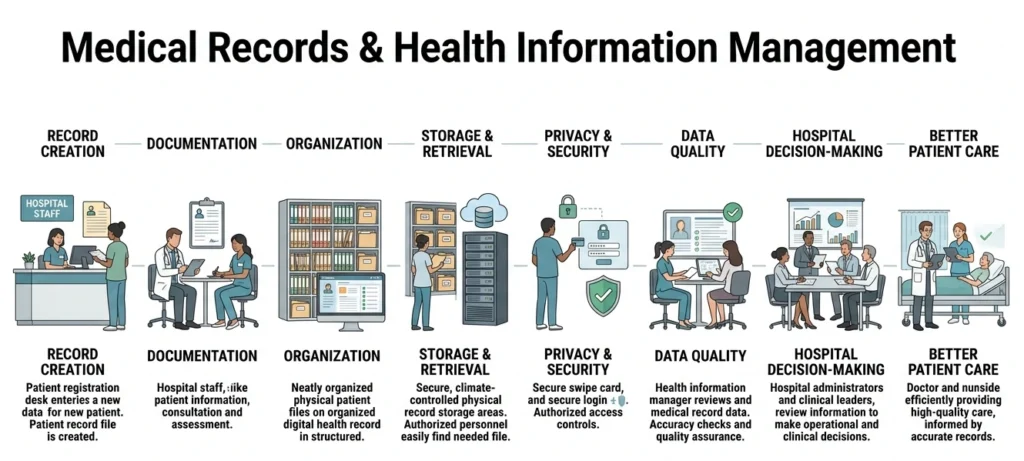
As hospitals increasingly move from paper-based documentation to digital systems, the volume and complexity of health information continue to grow. Electronic records can make information easier to access and share, but they also create new responsibilities around data quality, privacy, security, and appropriate access.
For hospital administrators, understanding how medical records and health information are managed is therefore an important part of managing efficient and patient-centered healthcare services.
What Are Medical Records?
A medical record is a documented account of a patient’s healthcare journey. It may contain information collected during registration, clinical consultations, diagnostic investigations, treatment, hospitalization, discharge, and follow-up care.
Depending on the type of healthcare service and the patient’s needs, a record may include demographic information, medical history, clinical observations, diagnosis, laboratory results, imaging reports, medication details, procedures, nursing notes, and discharge information.
The purpose of maintaining these records is to create reliable information about the care provided to a patient. When documentation is complete and accurate, healthcare professionals can use it to understand previous treatments, identify relevant medical information, and support continuity of care.
Medical records also serve purposes beyond direct clinical care. Hospitals may use appropriately managed information for quality assessment, administrative planning, reporting, research, and other legitimate healthcare activities.
This makes medical records an important information resource within a hospital rather than simply a collection of documents.
Why Accurate Medical Records Matter
The value of a medical record depends heavily on the quality of the information it contains. Incomplete, inaccurate, outdated, or poorly organized records can make it more difficult for healthcare teams to understand a patient’s history and make informed decisions.
Accurate documentation can support communication between healthcare professionals, reduce confusion, and provide a consistent record of the patient’s treatment journey. It can also help hospitals review whether appropriate processes were followed and identify areas where care or documentation can be improved.
For hospital administrators, this means medical record management is closely connected with both operational efficiency and the quality of healthcare services.
The broader management of patient information becomes especially important as hospitals handle increasingly large volumes of digital and paper-based data. This is where health information management becomes a distinct and essential function.
What Is Health Information Management?
Health Information Management (HIM) is the systematic process of collecting, organizing, maintaining, protecting, and using health information throughout its lifecycle. In a hospital, this includes managing information generated during patient registration, diagnosis, treatment, hospitalization, discharge, and follow-up care.
While a medical record is the documented account of an individual patient’s care, health information management focuses on how that information is handled and used within the healthcare organization. This includes ensuring that information is accurate, accessible to authorized users, properly stored, and protected from inappropriate access.
HIM therefore connects clinical information with the administrative and operational needs of a hospital. Well-managed health information can help healthcare teams access relevant patient information while also supporting reporting, quality improvement, planning, and other legitimate hospital functions.
Why Medical Records Matter in Hospitals
Medical records are important because they provide a continuous source of information about a patient’s healthcare journey. When different healthcare professionals are involved in a patient’s care, accurate documentation helps them understand relevant history, investigations, treatments, and clinical decisions.
Supporting Patient Care
A complete medical record can help healthcare professionals review previous information before making decisions about ongoing care. It provides a documented history that can support continuity when a patient moves between departments, clinicians, or stages of treatment.
Accurate records are particularly important when patients have complex medical histories or receive care from multiple healthcare professionals.
Improving Communication Between Healthcare Teams
Hospitals depend on communication between doctors, nurses, laboratory teams, pharmacists, administrators, and other professionals. Medical records provide a common source of documented information that can support this communication.
When information is clearly documented and available to authorized healthcare professionals, it can reduce unnecessary duplication and help different teams understand what has already been recorded or done.
Supporting Hospital Operations
Medical information also has an administrative role. Hospitals need reliable information to manage services, monitor activities, plan resources, prepare reports, and evaluate how different departments are functioning.
For example, information generated through patient records can contribute to understanding service utilization, admission patterns, length of stay, discharge activity, and other operational indicators.
This makes medical records relevant not only to clinical teams but also to hospital administrators responsible for planning and managing healthcare services.
Legal and Regulatory Importance
Medical records can also serve as important documentation of the care provided to a patient. Proper documentation can help establish what was recorded, what services were provided, and how care progressed over time.
Hospitals therefore need processes that support appropriate documentation, retention, access, and protection of health information in accordance with applicable requirements.
Research, Reporting and Healthcare Planning
When health information is appropriately collected, managed, and used, it can support healthcare research, reporting, service planning, and quality improvement.
Aggregated and appropriately handled information can help hospitals identify patterns in service use and outcomes. At a broader level, health information can contribute to planning and evaluating healthcare services.
The value of this information depends on its quality. If records are incomplete, inconsistent, or difficult to retrieve, their usefulness for clinical, administrative, and planning purposes can be reduced.
This is why effective medical records management is an important foundation for reliable health information within modern hospitals.
Types of Medical Records
Hospitals generate different types of medical records depending on the patient’s needs, the type of care provided, and the stage of the healthcare journey. Although the format and content may differ, each record contributes to documenting patient care and maintaining reliable health information.
Understanding these different records is important for hospital administrators because effective management depends on knowing how information is created, used, stored, and retrieved across different departments.
Paper-Based Medical Records
Paper records have traditionally been used to document patient information in hospitals. They may contain handwritten clinical notes, investigation reports, prescriptions, nursing documentation, consent forms, discharge summaries, and other relevant documents.
Although paper records are straightforward in concept, managing large volumes of physical files can require considerable space, staff time, and administrative processes. Locating a particular record can also become difficult when files are stored across different departments or facilities.
Hospitals using paper-based systems therefore need clear processes for filing, indexing, retrieval, movement, retention, and secure storage.
Electronic Medical Records
Electronic medical records store patient information in digital form. Depending on the healthcare setting and system design, they can contain clinical notes, diagnoses, laboratory results, medication information, imaging reports, and other patient-related information.
Digital records can make authorized information easier to retrieve and support faster access to patient information across relevant points of care. However, their effectiveness depends on accurate documentation, appropriate system design, user training, access controls, and reliable data management.
Electronic medical records should therefore not be viewed simply as a replacement for paper files. They are part of a broader process of managing health information throughout its lifecycle.
Outpatient Records
Outpatient records document healthcare provided when a patient does not require hospital admission. These may include consultation notes, clinical findings, prescriptions, investigation reports, diagnoses, and follow-up information.
Maintaining accurate outpatient records helps healthcare professionals understand previous consultations and supports continuity when patients return for further care.
Inpatient Records
Inpatient records contain information generated during a patient’s hospital admission. Depending on the case, these may include admission documentation, clinical notes, nursing records, investigation reports, treatment information, medication records, procedures, progress notes, and discharge documentation.
Because inpatient care often involves multiple healthcare professionals and departments, organized records are particularly important for maintaining continuity and communication throughout the admission.
Emergency Records
Emergency departments often operate under time-sensitive conditions. Emergency records document the patient’s presenting condition, initial assessment, investigations, treatment, procedures, and disposition.
Accurate documentation is important because emergency information may later become relevant to inpatient care, follow-up treatment, or future healthcare encounters.
Diagnostic and Laboratory Records
Laboratory reports, imaging results, pathology findings, and other diagnostic information form an important part of a patient’s medical record.
These records provide evidence that can support diagnosis, treatment decisions, monitoring, and follow-up. Their accurate identification, storage, retrieval, and association with the correct patient are therefore essential aspects of medical records management.
Discharge Records
Discharge documentation summarizes important information about a patient’s hospital stay and ongoing care. It may include the diagnosis, treatment provided, condition at discharge, medications, follow-up instructions, and other relevant information.
A clear discharge record can help ensure that information is communicated appropriately when the patient continues care outside the hospital or with another healthcare provider.
Together, these different types of records create a broader picture of a patient’s healthcare journey. Managing them effectively requires hospitals to establish consistent processes for documentation, organization, storage, retrieval, retention, and protection of health information.
Medical Records Management in Modern Hospitals
Managing medical records involves much more than storing patient files. Hospitals need a structured process that allows information to be created accurately, organized systematically, retrieved when required, retained for the appropriate period, and eventually archived or disposed of securely.
A well-managed records process helps ensure that authorized healthcare professionals can access the information they need while reducing the risk of misplaced, incomplete, duplicated, or improperly handled records.
Record Creation and Documentation
The management process begins when patient information is created. Registration details, clinical observations, diagnostic findings, treatment information, nursing documentation, and other relevant information need to be recorded accurately.
Documentation should be clear, consistent, timely, and relevant to the patient’s care. Poor documentation at the beginning of the process can create problems later when information is retrieved for clinical, administrative, legal, or quality-related purposes.
Classification and Organization
Once information is recorded, hospitals need systems for organizing it so that records can be identified and retrieved efficiently.
Paper-based records may require structured filing and indexing systems, while electronic records rely on digital organization, identifiers, and database structures. Regardless of the format, consistent organization reduces the possibility of records being misplaced or incorrectly associated with another patient.
For hospital administrators, effective organization is important because delays in retrieving information can affect both workflow and service efficiency.
Storage and Retrieval
Medical records need to remain accessible to authorized users while being protected from loss, damage, or inappropriate access.
In paper-based environments, this requires suitable storage areas, controlled movement of files, and systems for tracking records when they are transferred between departments. Digital environments require reliable storage infrastructure, access controls, backups, and appropriate security measures.
The objective is not simply to store information but to ensure that the right information can be retrieved by the right person when it is needed.
Retention and Archiving
Hospitals may need to retain medical records for defined periods based on applicable requirements and the nature of the information. Records that are no longer actively used may be moved to an appropriate archival system rather than remaining in active storage.
A structured retention and archiving process can help hospitals manage growing volumes of information while ensuring that records are not removed prematurely or retained without a clear purpose.
Secure Disposal
When records reach the end of their required retention period, disposal must be handled carefully. Medical records contain sensitive patient information, so they should not simply be discarded like ordinary documents.
Paper records may require secure destruction, while digital information may require appropriate deletion or disposal procedures based on the storage environment and applicable requirements.
The overall process should maintain confidentiality and provide appropriate documentation of how records were disposed of.
Electronic Records and Digital Information Management
The transition from paper records to electronic medical records has changed how hospitals create, access, and manage health information. Digital records can improve accessibility and reduce dependence on physical storage, but they also require stronger attention to system reliability, data quality, user access, and information security.
An electronic medical record should therefore be understood as part of a wider hospital information environment rather than as an isolated technology.
This is where a Hospital Information System can connect different information processes and support the movement of relevant information across hospital operations.
Effective digital record management ultimately depends on more than technology. Hospitals also need clearly defined procedures, trained staff, appropriate access controls, and regular monitoring to ensure that health information remains accurate, available, and protected.
Privacy, Confidentiality and Security of Health Information
Medical records contain sensitive information about a patient’s health, treatment, and personal circumstances. Protecting this information is therefore a fundamental responsibility of health information management.
Hospitals need to ensure that patient information is available to authorized users when required for care or legitimate administrative purposes, while preventing inappropriate access, disclosure, alteration, or loss.
Patient Confidentiality
Confidentiality means protecting patient information from being disclosed to people who are not authorized to receive it.
Healthcare organizations need clear procedures that define who can access particular information and under what circumstances. Staff members who handle medical records also need to understand their responsibilities when viewing, sharing, storing, or communicating patient information.
Confidentiality is particularly important because patients need confidence that information shared during healthcare interactions will be handled responsibly.
Controlling Access to Health Information
Access to medical records should be based on legitimate requirements rather than unrestricted availability.
In digital systems, hospitals can use user accounts, permissions, authentication, and access controls to limit information to appropriate users. Paper-based environments also require controlled access to storage areas and proper procedures for handling physical files.
Effective access management helps reduce the risk of unauthorized use while allowing healthcare professionals to obtain information needed for patient care.
Protecting Digital Health Information
The shift toward electronic records has increased the importance of information security. Digital health information can be affected by unauthorized access, accidental loss, system failures, or other security incidents.
Hospitals therefore need appropriate technical and administrative safeguards, including secure systems, controlled access, backups, staff awareness, and procedures for responding to information-security problems.
Security should be treated as an ongoing responsibility rather than a one-time technical activity.
Maintaining Data Integrity
Protecting health information also means ensuring that information remains accurate and is not improperly altered.
Incorrect or incomplete information can affect clinical communication, administrative reporting, and decision-making. Hospitals therefore need processes that support accurate documentation, appropriate updates, and accountability for changes made to records.
Privacy and Hospital Administration
Privacy and information security are not only technical concerns. They are also management responsibilities.
Hospital administrators need to establish policies, allocate appropriate resources, train staff, monitor compliance, and ensure that information-handling practices are integrated into everyday hospital operations.
As hospitals increasingly rely on healthcare data management, maintaining appropriate controls over information becomes essential for both operational efficiency and responsible healthcare delivery.
Strong privacy and security practices help hospitals protect patients while maintaining the availability and reliability of information needed for healthcare services.
Data Quality in Health Information Management
The usefulness of health information depends on the quality of the information being collected and maintained. In a hospital, incomplete, inaccurate, inconsistent, or outdated records can affect clinical communication, administrative reporting, and decision-making.
Health information management therefore requires processes that help maintain reliable information throughout the record lifecycle.
Accuracy of Health Information
Accurate information reflects the patient’s actual healthcare situation and the care that has been provided. Errors in patient details, clinical documentation, diagnostic information, or treatment records can create confusion and may affect subsequent healthcare decisions.
Hospitals need clear documentation practices and appropriate review processes to reduce avoidable errors.
Completeness of Records
A record should contain the information required for its intended purpose. Missing clinical notes, investigation results, treatment information, or discharge documentation can make it difficult to understand the patient’s complete healthcare journey.
Complete records are also important when information is later used for administrative review, quality assessment, reporting, or healthcare planning.
Timeliness of Information
Health information needs to be recorded and made available at an appropriate time. Delayed documentation can make it difficult for healthcare professionals to understand recent developments in a patient’s care.
Timely information is particularly important in hospital environments where several departments may depend on updated information to coordinate services.
Consistency Across Records
Information may be generated in multiple departments and systems. Differences in patient identifiers, terminology, dates, or other details can create inconsistencies that reduce the reliability of health information.
Standardized documentation and appropriate information-management processes can help maintain consistency across records.
Accessibility of Health Information
Good health information management aims to make relevant information accessible to authorized users when they need it.
Accessibility does not mean unrestricted access. Hospitals need to balance availability with privacy and security requirements so that information can support healthcare delivery without exposing sensitive patient data unnecessarily.
Medical Records and Healthcare Quality
Reliable health information can also contribute to hospital quality management. Hospitals can review records to assess documentation practices, identify gaps, monitor processes, and support quality-improvement activities.
When data is accurate, complete, timely, consistent, and appropriately accessible, it becomes more useful for both patient care and hospital administration.
Using Health Information for Better Decisions
Hospital administrators increasingly depend on reliable information to understand service utilization, monitor performance, plan resources, and identify areas that require improvement.
Poor-quality information can lead to inaccurate reports or incomplete understanding of hospital activities. Strong health information management therefore provides an important foundation for evidence-based administrative decision-making.
The quality of information ultimately depends on the processes and people responsible for creating, maintaining, reviewing, and using it. For this reason, data quality should be treated as an ongoing management responsibility rather than a final check performed only after records have been created.
The Role of Health Information Management in Hospital Administration
Health information management is not limited to maintaining patient records. It supports several administrative functions that help hospitals understand their operations, monitor performance, improve services, and make informed decisions.
For hospital administrators, reliable health information provides a foundation for managing both day-to-day activities and longer-term planning.
Supporting Administrative Decision-Making
Hospital administrators need accurate information to understand how services are being used and where resources may be required.
Information from medical records can contribute to monitoring admissions, discharges, service utilization, length of stay, and other operational indicators. When this information is properly managed, it can support evidence-based decisions rather than relying only on assumptions or incomplete information.
Supporting Hospital Performance
Health information can also contribute to healthcare performance management by helping administrators monitor activities and identify areas that may require improvement.
Performance information becomes more useful when the underlying records are accurate, complete, and consistently maintained.
Supporting Compliance and Reporting
Hospitals may need to maintain records and prepare reports to meet applicable organizational, legal, regulatory, or accreditation requirements.
Health information management helps establish processes for documentation, retrieval, retention, and controlled access to information required for these purposes.
Effective healthcare compliance management therefore depends partly on having reliable information and clearly defined processes for managing it.
Supporting Quality Improvement
Medical records can provide information that hospitals use to review healthcare processes and identify opportunities for improvement.
Record reviews and health information analysis can help organizations examine documentation practices, identify gaps, and support quality-improvement initiatives.
This makes health information management an important link between documentation and broader hospital quality efforts.
Supporting Resource Planning
Hospitals need to plan staff, beds, equipment, facilities, and other resources according to the services they provide and the needs of their patients.
Reliable health information can help administrators understand patterns in service utilization and use this information when planning resources.
The usefulness of such planning depends on the quality and consistency of the information being analyzed.
The Changing Role of Health Information Professionals
As healthcare organizations become increasingly dependent on digital information, health information professionals are involved in more than traditional records management.
Their responsibilities can include information quality, data governance, privacy, security, documentation processes, reporting, and coordination between clinical and administrative information needs.
This changing role makes health information management increasingly relevant to modern hospital administration.
For MHA professionals, understanding how health information is generated, managed, protected, and used can help them work more effectively with clinical teams, administrative departments, and hospital information systems.
Building a Stronger Information Management Approach
Effective health information management requires coordination between people, processes, technology, and organizational policies. Hospitals need trained staff, clear documentation procedures, reliable systems, appropriate access controls, and regular monitoring of information quality.
When these elements work together, medical records become more than stored patient information. They become a reliable resource for patient care, hospital operations, quality improvement, compliance, and informed management decisions.
Sources & References
- World Health Organization (WHO) — Health information systems, digital health, patient information, data governance and health information management.
- World Health Organization (WHO) — Guidance and resources related to patient safety, health information and quality of healthcare.
- Ministry of Health & Family Welfare, Government of India — Healthcare systems, digital health initiatives and health information-related policies in India.
- National Health Authority (NHA), Government of India — Digital health ecosystem, health records and the Ayushman Bharat Digital Mission.
- Indian Council of Medical Research (ICMR) — Biomedical and health research resources, including guidance relevant to health information and medical research.
- National Accreditation Board for Hospitals & Healthcare Providers (NABH) — Hospital quality, patient safety, documentation and healthcare standards.
- National Digital Health Mission / ABDM — Digital health records, interoperability and secure exchange of health information in India.
