
Hospital Information System (HIS): Transforming Modern Hospital Administration Through Digital Healthcare
Healthcare is experiencing one of its biggest transformations in history. Hospitals are rapidly replacing paper-based records and manual administrative processes with intelligent digital systems that improve patient care, streamline operations, and support faster clinical decision-making. In India, initiatives such as the Ayushman Bharat Digital Mission (ABDM) are accelerating this digital shift, encouraging healthcare organizations to adopt integrated technologies that enhance efficiency, transparency, and continuity of care.
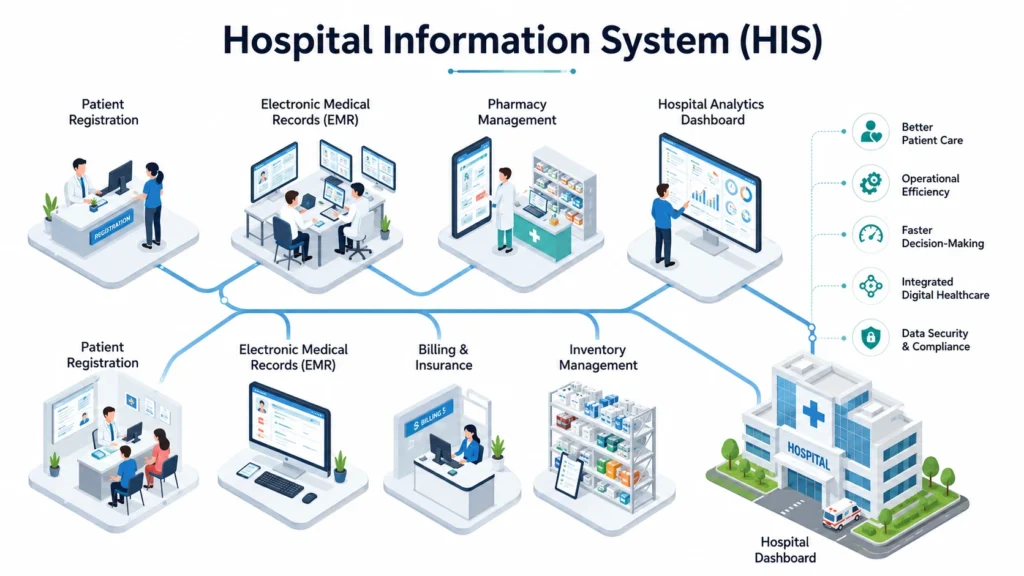
Today’s hospitals generate enormous amounts of patient, clinical, financial, and operational data every single day. Managing this information manually is not only time-consuming but also increases the chances of errors, delays, duplicate records, and communication gaps between departments. A Hospital Information System (HIS) addresses these challenges by bringing every essential hospital function onto a single digital platform, allowing healthcare professionals to access accurate information whenever they need it.
Hospitals that successfully implement an HIS are able to improve patient experiences, strengthen coordination between departments, optimize resources, reduce administrative burden, and make evidence-based decisions. These benefits directly support hospital operations management, helping administrators ensure smooth day-to-day functioning across clinical and non-clinical departments.
The growing adoption of artificial intelligence, cloud computing, electronic health records, and data analytics has further increased the importance of digital healthcare solutions. Today, digital technologies in hospital administration are no longer optional-they have become an essential part of delivering efficient, patient-centered healthcare services.
For students pursuing a Master of Hospital Administration (MHA), understanding Hospital Information Systems is no longer limited to learning hospital software. It involves understanding how technology supports administration, improves communication, enhances patient safety, strengthens compliance, and contributes to better healthcare outcomes.
Hospital Information Systems are a key part of modern hospital administration, helping healthcare organizations streamline operations, improve patient care, and make data-driven decisions. To understand how digital systems fit into the broader field of healthcare management, explore our comprehensive guide on Hospital Administration.
What Is a Hospital Information System (HIS)?
A Hospital Information System (HIS) is an integrated digital platform that manages and connects the clinical, administrative, financial, and operational activities of a hospital. Instead of maintaining separate records across different departments, HIS centralizes information so that authorized healthcare professionals can access accurate and real-time data whenever required.
An HIS acts as the digital backbone of a healthcare organization by connecting registration desks, outpatient departments, inpatient services, laboratories, pharmacies, radiology units, billing sections, nursing stations, and hospital administration into one coordinated system. This integrated approach improves communication, reduces duplication of work, and enables faster decision-making.
Beyond improving clinical workflows, HIS also supports hospital financial management by automating billing processes, tracking revenue, monitoring expenses, and generating financial reports for administrators.
Most modern Hospital Information Systems include modules for:
- Patient Registration
- Electronic Medical Records (EMR)
- Appointment Scheduling
- Laboratory Information Management
- Pharmacy Management
- Radiology Information System
- Billing & Insurance
- Inventory Management
- Human Resource Management
- Reporting & Analytics
Instead of working independently, these modules continuously exchange information, allowing hospitals to operate as a connected healthcare ecosystem.
Why Do Hospitals Need a Hospital Information System?
Modern hospitals handle thousands of patient interactions and administrative activities every day. Managing these complex processes manually often results in delays, miscommunication, and operational inefficiencies. A Hospital Information System helps hospitals deliver faster, safer, and more coordinated healthcare services.
Improves Patient Care
Doctors, nurses, and healthcare professionals can instantly access complete patient records, laboratory reports, prescriptions, allergies, and treatment history. This enables quicker diagnosis, better clinical decisions, and improved continuity of care.
Enhances Operational Efficiency
By automating routine administrative tasks such as patient registration, appointment scheduling, billing, and reporting, HIS significantly improves operational efficiency while reducing paperwork and repetitive manual work.
Strengthens Departmental Coordination
Departments such as OPD, IPD, Pharmacy, Laboratory, Radiology, Billing, and Administration work with synchronized information, reducing communication gaps and improving collaboration throughout the hospital.
Supports Better Resource Management
Hospital administrators can monitor bed occupancy, staff allocation, equipment utilization, medicine inventory, and patient movement through centralized dashboards, enabling better resource planning and decision-making.
Ensures Data Accuracy and Compliance
Digital records minimize duplication, improve documentation accuracy, and support compliance with healthcare regulations, accreditation standards, and institutional policies.
Healthcare Insight
A Hospital Information System is much more than hospital software. It serves as the central nervous system of a modern healthcare organization by connecting people, processes, technology, and data. Hospitals that effectively use HIS are better equipped to improve patient safety, optimize resources, strengthen administrative efficiency, and deliver high-quality healthcare services.
Key Components of a Hospital Information System (HIS)
A Hospital Information System is not a single software application but a collection of interconnected modules that work together to support every major hospital function. Each module manages a specific department while continuously sharing information with other departments, ensuring seamless coordination across the healthcare organization.
Understanding these components helps hospital administrators appreciate how technology improves operational efficiency, patient care, and organizational performance.
1. Patient Registration and Appointment Management
The patient registration module is usually the first point of interaction between patients and the hospital. It records demographic details, assigns a unique patient identification number, schedules appointments, and maintains patient visit history.
An efficient registration system reduces waiting time, eliminates duplicate records, and ensures that patient information is available across every department throughout the treatment journey.
Many hospitals also integrate online appointment booking, SMS reminders, and digital registration portals to improve patient convenience and reduce administrative workload.
2. Electronic Medical Records (EMR)
Electronic Medical Records (EMR) store complete clinical information related to every patient, including medical history, diagnoses, laboratory reports, prescriptions, allergies, imaging reports, treatment plans, and discharge summaries.
Unlike paper-based files, EMRs allow authorized healthcare professionals to retrieve patient information instantly from different departments, supporting faster diagnosis and continuity of care.
Accurate electronic records also improve patient safety by reducing medication errors and avoiding duplication of diagnostic tests.
3. Laboratory Information Management System (LIMS)
The laboratory module manages the complete diagnostic testing workflow, from test requests and sample collection to result generation and report sharing.
Since laboratory reports are automatically linked with patient records, doctors receive faster access to diagnostic information, enabling quicker clinical decision-making and reducing delays in treatment.
Automation also minimizes manual errors while improving laboratory productivity.
4. Pharmacy Management System
The pharmacy module helps hospitals maintain medicine inventory, process prescriptions, manage drug dispensing, monitor stock availability, and track medicine expiry dates.
Digital pharmacy management reduces dispensing errors, prevents stock shortages, and ensures that prescribed medications are available when patients need them.
Efficient medicine management also supports better inventory planning and cost control.
5. Billing and Financial Management
Hospital Information Systems automate billing for consultations, investigations, procedures, admissions, pharmacy purchases, insurance claims, and other healthcare services.
Automated billing minimizes calculation errors, accelerates payment processing, improves revenue collection, and provides administrators with accurate financial reports for strategic planning.
These capabilities strengthen financial management by giving hospital administrators better visibility into revenue, expenses, and operational costs.
6. Inventory and Supply Chain Management
Hospitals consume thousands of medical supplies every day, including medicines, surgical equipment, diagnostic consumables, and personal protective equipment.
The inventory module continuously monitors stock levels, purchase orders, supplier information, and consumption patterns to ensure uninterrupted availability of essential healthcare resources.
Effective inventory monitoring reduces wastage, prevents shortages, and supports better resource utilization across departments.
7. Human Resource Management
Managing doctors, nurses, technicians, administrative staff, and support personnel is another important responsibility within hospitals.
The HR module records employee information, attendance, payroll, shift scheduling, training records, leave management, and performance data.
Automating HR processes improves workforce planning and enables administrators to allocate staff more efficiently.
8. Reporting and Analytics
One of the greatest strengths of a Hospital Information System is its ability to convert large volumes of hospital data into meaningful reports and dashboards.
Hospital administrators can monitor key performance indicators such as patient admissions, average length of stay, bed occupancy, revenue trends, departmental performance, and patient satisfaction.
These reports support performance indicators that help management identify operational challenges, measure healthcare quality, and make informed strategic decisions.
Healthcare Insight
The true value of a Hospital Information System lies not in individual software modules but in how these modules communicate with each other. When registration, clinical care, pharmacy, laboratory, billing, inventory, and administration operate through one integrated system, hospitals become more efficient, patient-centered, and capable of delivering high-quality healthcare services.
Benefits of a Hospital Information System (HIS)
A Hospital Information System offers far more than digital record-keeping. It transforms how hospitals function by improving clinical workflows, strengthening administration, enhancing patient experiences, and supporting better decision-making. Whether it is a multi-specialty hospital, a government healthcare institution, or a private medical center, an effective HIS creates measurable improvements across every department.
1. Better Patient Care and Safety
One of the biggest advantages of a Hospital Information System is its ability to improve the quality of patient care. Since healthcare professionals can instantly access accurate patient information, treatment decisions become faster and more informed.
Doctors can review previous diagnoses, laboratory reports, prescriptions, allergies, and treatment history without waiting for physical files. This reduces medical errors, prevents duplicate investigations, and supports continuity of care throughout the patient’s treatment journey.
When information flows smoothly between departments, patients experience shorter waiting times and more coordinated healthcare services.
2. Faster Clinical Decision-Making
Healthcare decisions often depend on timely access to accurate information. A Hospital Information System allows clinicians to retrieve laboratory reports, radiology images, prescriptions, and patient histories in real time.
Instead of waiting for paper files or manually transferring information between departments, doctors receive updated clinical information immediately, allowing them to make faster treatment decisions.
This is particularly valuable in emergency departments, intensive care units, and critical care settings where every minute matters.
3. Improved Administrative Efficiency
Hospital administrators manage hundreds of operational activities every day, including admissions, billing, inventory, staffing, compliance, reporting, and departmental coordination.
By automating repetitive administrative processes, HIS reduces paperwork, minimizes manual errors, and allows administrators to focus on strategic planning instead of routine documentation.
Digital workflows also reduce duplication of work across departments and improve communication throughout the organization.
4. Better Resource Utilization
Hospitals invest significant resources in medical equipment, medicines, hospital beds, infrastructure, and healthcare professionals. Managing these resources efficiently is essential for maintaining high-quality healthcare services.
A Hospital Information System provides real-time visibility into bed occupancy, equipment availability, medicine inventory, staff allocation, and patient movement across departments.
This helps administrators optimize available resources, reduce unnecessary delays, and improve hospital productivity.
5. Accurate Financial Management
Financial sustainability is an important aspect of hospital administration. HIS automates billing, insurance processing, payment tracking, revenue monitoring, and financial reporting, reducing manual calculations and administrative delays.
Accurate financial information enables hospital management to identify operational costs, monitor departmental performance, and make informed budgeting decisions.
Hospitals that use integrated financial systems are better positioned to improve transparency and maintain long-term financial stability.
6. Stronger Data Security and Regulatory Compliance
Healthcare organizations handle highly sensitive patient information that must be protected against unauthorized access and data loss.
Modern Hospital Information Systems include role-based access controls, audit trails, secure authentication, automatic backups, and encrypted databases to improve data security.
These systems also help hospitals maintain proper documentation for quality standards, accreditation requirements, and regulatory compliance.
7. Data-Driven Decision Making
Modern hospitals generate large amounts of operational and clinical data every day. Without proper analysis, much of this information remains underutilized.
Hospital Information Systems convert raw healthcare data into meaningful dashboards and reports that support informed decision-making.
Administrators can evaluate patient volumes, departmental performance, revenue trends, hospital occupancy, resource utilization, and service quality using real-time analytics.
Organizations that rely on healthcare data analytics are better equipped to identify operational challenges, improve healthcare quality, and plan future expansion.
8. Improved Patient Satisfaction
Patients today expect healthcare services that are fast, organized, and transparent. Long waiting times, repeated paperwork, and communication gaps often reduce patient satisfaction.
By simplifying appointment scheduling, reducing registration time, improving coordination between departments, and providing quicker access to reports, HIS enhances the overall patient experience.
Higher patient satisfaction also strengthens a hospital’s reputation and supports long-term organizational growth.
Healthcare Insight
A Hospital Information System creates value beyond technology. It enables hospitals to deliver safer patient care, strengthen administrative efficiency, improve financial performance, and support evidence-based decision-making. As healthcare continues to become more digital, hospitals that effectively use HIS are better prepared to meet rising patient expectations while maintaining operational excellence.
Challenges of Implementing a Hospital Information System
While a Hospital Information System offers significant advantages, implementing it successfully requires careful planning, investment, and organizational commitment. Technology alone cannot transform a hospital unless healthcare professionals, administrators, and management work together to adopt new digital processes.
Understanding these challenges helps future hospital administrators prepare for real-world implementation and develop practical solutions that support long-term digital transformation.
1. High Initial Investment
Implementing a Hospital Information System requires substantial financial investment. Hospitals need to purchase software, computer systems, networking infrastructure, servers or cloud services, cybersecurity solutions, and licensed applications.
In addition to technology costs, hospitals must also invest in employee training, system maintenance, software upgrades, and technical support.
Although implementation costs may appear high initially, many hospitals recover these investments over time through improved operational efficiency, reduced paperwork, better resource utilization, and fewer administrative errors.
2. Resistance to Change
One of the biggest challenges during digital transformation is resistance from employees who are accustomed to traditional paper-based workflows.
Doctors, nurses, administrative staff, and technicians may initially hesitate to adopt new digital systems because of unfamiliar technology, increased learning requirements, or concerns about workflow disruption.
Successful implementation depends on continuous communication, leadership support, and structured change management that encourages staff participation throughout the transition.
3. Training and Skill Development
Even the most advanced Hospital Information System cannot deliver expected results if users are not properly trained.
Healthcare professionals must understand how to enter patient information accurately, retrieve clinical records, manage digital documentation, and use various system modules effectively.
Regular training programs help employees build confidence, reduce errors, and improve system adoption across departments.
Educational institutions offering Hospital Administration programs are also placing greater emphasis on digital healthcare management skills to prepare future healthcare leaders for technology-driven hospitals.
4. Data Privacy and Cybersecurity Risks
Hospitals store large volumes of sensitive patient information, making healthcare organizations attractive targets for cyberattacks and data breaches.
Protecting confidential medical records requires strong cybersecurity measures, including encrypted databases, secure authentication, access control, regular security updates, and continuous system monitoring.
Hospital administrators must also establish clear policies regarding data access, password management, and information security to reduce organizational risk.
5. System Integration Challenges
Many hospitals already use separate software applications for laboratory services, pharmacy management, radiology, accounting, or human resources.
Integrating these independent systems into one centralized Hospital Information System can be technically complex.
Poor system integration may result in duplicate records, inconsistent information, communication delays, and reduced operational efficiency.
Selecting scalable and interoperable healthcare software helps organizations overcome these integration challenges.
6. Downtime and Technical Issues
Technology systems occasionally experience software failures, hardware problems, network outages, or scheduled maintenance.
When a Hospital Information System becomes temporarily unavailable, patient registration, billing, laboratory reporting, and clinical workflows may be affected.
Hospitals therefore require backup procedures, disaster recovery plans, regular data backups, and dedicated IT support teams to ensure continuity of healthcare services.
7. Maintaining Data Quality
A Hospital Information System is only as reliable as the information entered into it.
Incomplete patient records, duplicate entries, incorrect documentation, or delayed data updates reduce the effectiveness of the system and can influence clinical as well as administrative decisions.
Hospitals should establish standardized documentation practices, routine audits, and quality checks to maintain accurate healthcare information.
8. Continuous System Upgrades
Healthcare technology evolves rapidly. Regulatory requirements, cybersecurity standards, artificial intelligence, cloud computing, and healthcare analytics continue to advance every year.
Hospitals must regularly update their Hospital Information Systems to improve functionality, strengthen security, and remain compatible with emerging healthcare technologies.
Organizations that treat HIS as a continuously evolving platform rather than a one-time software installation are more likely to achieve long-term success.
Healthcare Insight
Implementing a Hospital Information System is not simply an IT project-it is an organizational transformation. Hospitals that combine strong leadership, employee training, secure technology, and continuous process improvement are more successful in overcoming implementation challenges and maximizing the long-term benefits of digital healthcare systems.
Future Trends in Hospital Information Systems
Healthcare technology is evolving at an unprecedented pace, and Hospital Information Systems are becoming smarter, faster, and more interconnected. Today’s HIS platforms are no longer limited to storing patient records or automating administrative tasks. They are increasingly incorporating artificial intelligence, cloud computing, predictive analytics, and digital health technologies that improve clinical outcomes and operational efficiency.
For future hospital administrators, understanding these emerging trends is essential because digital transformation will continue to redefine how hospitals are managed.
1. Artificial Intelligence in Hospital Information Systems
Artificial Intelligence (AI) is becoming an important component of modern Hospital Information Systems. AI-powered solutions can analyze large volumes of healthcare data, identify clinical patterns, predict patient risks, automate repetitive administrative tasks, and assist healthcare professionals in making informed decisions.
Hospitals are already using AI for appointment scheduling, medical imaging support, clinical documentation, patient triage, and resource forecasting.
As AI technologies continue to mature, they will further improve hospital efficiency while allowing healthcare professionals to focus more on patient care.
2. Cloud-Based Hospital Information Systems
Traditional hospital software often required expensive on-site servers and complex infrastructure. Cloud-based Hospital Information Systems offer greater flexibility by allowing hospitals to securely access healthcare information through internet-enabled platforms.
Cloud technology simplifies software updates, improves data backup, supports remote access, and reduces hardware maintenance costs.
It also enables multi-location hospitals to share information more efficiently while maintaining centralized healthcare records.
3. Integration with National Digital Health Initiatives
Countries around the world are investing in digital healthcare infrastructure to improve accessibility and continuity of care.
In India, initiatives such as the Ayushman Bharat Digital Mission (ABDM) are encouraging hospitals to adopt standardized digital health records and interoperable healthcare systems.
As national digital health ecosystems continue to expand, Hospital Information Systems will play a central role in securely exchanging patient information across healthcare providers.
4. Mobile Healthcare Applications
Modern patients increasingly expect healthcare services to be available through smartphones and digital platforms.
Many Hospital Information Systems now integrate with mobile applications that allow patients to schedule appointments, access laboratory reports, receive prescriptions, view discharge summaries, and communicate with healthcare providers.
These digital services improve patient convenience while reducing administrative workload for hospitals.
5. Predictive Analytics for Better Decision-Making
Healthcare organizations generate enormous amounts of operational and clinical data every day.
Advanced analytics integrated within Hospital Information Systems can identify trends, forecast patient admissions, estimate medicine requirements, predict disease outbreaks, and optimize resource allocation.
Instead of reacting to problems after they occur, hospitals can use predictive insights to improve planning and deliver proactive healthcare services.
6. Internet of Medical Things (IoMT)
Medical devices are becoming increasingly connected through secure digital networks.
Equipment such as patient monitors, infusion pumps, wearable health devices, and diagnostic machines can automatically transmit information to Hospital Information Systems.
This continuous flow of real-time clinical data improves patient monitoring, supports early intervention, and reduces manual documentation.
7. Stronger Cybersecurity and Data Protection
As hospitals become more digital, protecting healthcare information will remain a top priority.
Future Hospital Information Systems will continue to strengthen cybersecurity through advanced encryption, multi-factor authentication, automated threat detection, artificial intelligence-based security monitoring, and continuous risk assessment.
These improvements will help healthcare organizations safeguard confidential patient information while maintaining trust and regulatory compliance.
8. Data-Driven Hospital Administration
Future hospital administrators will increasingly rely on real-time dashboards instead of traditional reports.
Hospital Information Systems will provide live operational insights into bed occupancy, patient flow, staffing levels, financial performance, resource utilization, and service quality.
This growing emphasis on data-driven hospital administration will enable healthcare leaders to make faster, evidence-based decisions that improve both patient outcomes and organizational performance.
Healthcare Insight
The future of Hospital Information Systems extends beyond digitizing hospital records. Emerging technologies such as artificial intelligence, cloud computing, predictive analytics, connected medical devices, and national digital health platforms are creating smarter healthcare ecosystems. Hospital administrators who understand these innovations will be better prepared to lead hospitals through the next phase of digital healthcare transformation.
Why Hospital Information Systems Matter for Future Hospital Administrators
The role of hospital administrators has evolved significantly over the past decade. Modern healthcare organizations no longer depend solely on managerial skills; they also require leaders who can effectively manage digital healthcare systems, analyze operational data, improve organizational efficiency, and support technology-driven decision-making.
As hospitals continue adopting advanced digital solutions, understanding Hospital Information Systems has become an essential competency for aspiring healthcare managers.
Managing Digital Hospital Operations
Hospital administrators are responsible for ensuring that every department functions efficiently while delivering high-quality patient care.
A Hospital Information System provides administrators with centralized access to patient flow, bed occupancy, staffing schedules, financial reports, inventory levels, and departmental performance. Instead of relying on manual reports, administrators can monitor hospital operations through real-time dashboards that support faster and more informed decisions.
This digital visibility enables healthcare organizations to improve coordination, reduce operational delays, and optimize available resources.
Supporting Strategic Decision-Making
Hospital administrators frequently make decisions related to staffing, budgeting, service expansion, equipment procurement, quality improvement, and resource allocation.
Hospital Information Systems generate accurate operational data that helps management identify performance trends, evaluate organizational outcomes, and develop long-term healthcare strategies.
Rather than making decisions based on assumptions, administrators can rely on evidence-based insights generated through integrated healthcare information systems.
Improving Leadership and Communication
Successful hospital administration depends on effective collaboration between clinical departments, administrative teams, support services, and hospital leadership.
Because Hospital Information Systems connect multiple departments through one integrated platform, communication becomes faster and more transparent.
Administrators can coordinate activities across outpatient services, inpatient care, laboratories, pharmacies, finance, human resources, and quality departments while ensuring that every team has access to updated information.
Strengthening Quality Improvement Initiatives
Healthcare quality is measured through patient outcomes, service efficiency, safety standards, regulatory compliance, and patient satisfaction.
Hospital Information Systems help administrators monitor quality indicators by collecting reliable operational and clinical data from across the organization.
These insights support continuous quality improvement initiatives, accreditation preparedness, and organizational performance evaluation.
Preparing for Digital Healthcare Transformation
Healthcare is becoming increasingly technology-driven with the adoption of artificial intelligence, cloud computing, telemedicine, predictive analytics, and digital health platforms.
Hospital administrators who understand Hospital Information Systems are better prepared to lead digital transformation projects, manage technology implementation, and guide healthcare organizations through changing industry requirements.
Developing digital leadership skills has therefore become an important part of professional growth in hospital administration.
Building Career Opportunities
Knowledge of Hospital Information Systems is highly valued across hospitals, healthcare consulting firms, insurance companies, healthcare IT organizations, public health agencies, and accreditation bodies.
Professionals with expertise in healthcare information systems often work as:
- Hospital Administrators
- Healthcare Operations Managers
- Health Information Managers
- Quality Managers
- Healthcare Consultants
- Digital Health Coordinators
- Healthcare Project Managers
- Hospital IT Coordinators
As healthcare organizations continue investing in digital transformation, professionals with both management knowledge and technology skills will remain in high demand.
Developing Industry-Ready Skills Through MHA Programs
Master of Hospital Administration (MHA) programs are increasingly incorporating subjects related to healthcare information systems, digital healthcare management, hospital analytics, quality management, healthcare finance, and healthcare technology.
Students who gain practical exposure to Hospital Information Systems during their academic journey are better prepared to handle real-world hospital operations after graduation.
An MHA education that combines management principles with digital healthcare competencies creates graduates who can confidently lead modern healthcare organizations.
Building the Future of Digital Healthcare Leadership
Hospital Information Systems have become the foundation of modern hospital administration by connecting people, processes, and technology into one integrated healthcare ecosystem. From improving patient care and streamlining administrative workflows to supporting strategic planning and data-driven decision-making, HIS enables hospitals to operate more efficiently while meeting the growing expectations of patients and healthcare professionals.
For students and aspiring healthcare leaders, understanding Hospital Information Systems is no longer an optional skill—it is a professional necessity. As hospitals continue embracing digital transformation, administrators who combine healthcare management expertise with technological knowledge will be better equipped to lead organizations, improve healthcare quality, and shape the future of patient-centered healthcare delivery.
If you aspire to build a successful career in hospital administration, developing expertise in Hospital Information Systems will provide a strong foundation for managing the next generation of digitally enabled healthcare organizations.
Sources & References
The information presented in this article is based on guidance, publications, and healthcare resources from nationally and internationally recognized organizations, including:
- World Health Organization (WHO) – Digital Health and Health Information Systems
- Ministry of Health & Family Welfare (MoHFW), Government of India
- Ayushman Bharat Digital Mission (ABDM) – National Health Authority
- National Health Authority
- Healthcare Information and Management Systems Society (HIMSS)
- National Library of Medicine (PubMed) – Research Articles on Hospital Information Systems and Digital Health
