
What Is Infection Prevention and Control?
Infection Prevention and Control (IPC) refers to the practices and systems used in healthcare settings to reduce the risk of infections spreading between patients, healthcare workers and others within a facility.
Hospitals bring together people with different illnesses, varying levels of immunity and, in some cases, infectious conditions. Without effective infection prevention measures, healthcare settings themselves can become places where infections spread.
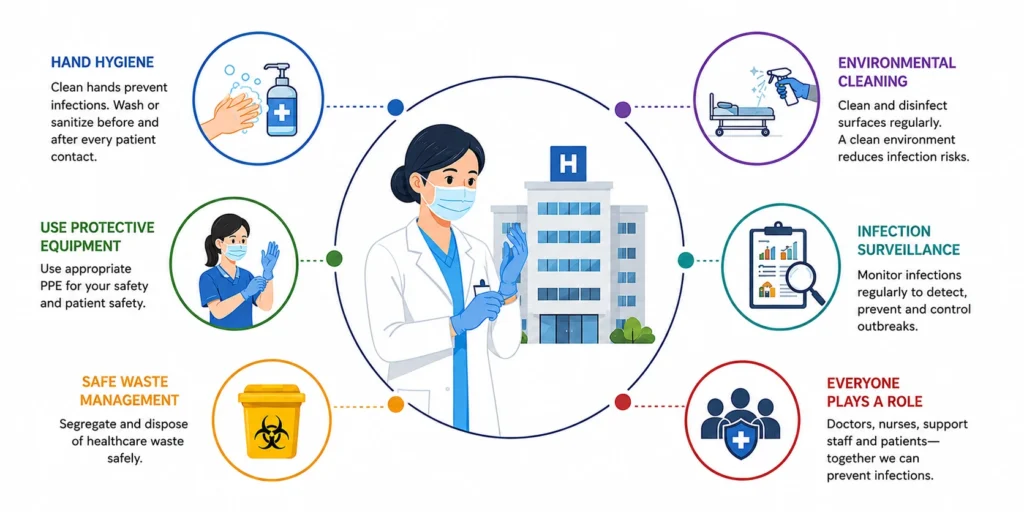
IPC therefore focuses on preventing avoidable transmission through measures such as:
- Hand hygiene
- Standard precautions
- Appropriate cleaning and disinfection
- Safe handling of medical equipment
- Appropriate use of personal protective equipment (PPE)
- Surveillance and monitoring of healthcare-associated infections and
- Infection control policies and staff training.
Healthcare-associated infections (HAIs) are among the important concerns addressed through IPC. These infections can occur during the process of receiving healthcare and may increase illness, prolong hospital stays and place additional pressure on healthcare resources.
Effective IPC programs are therefore closely connected with hospital quality management and the wider goal of delivering safe, reliable healthcare.
Why Infection Prevention and Control Matters in Hospitals
Infection prevention is not simply the responsibility of one department or a few healthcare professionals. Effective IPC requires coordination across the hospital-from doctors and nurses to housekeeping staff, laboratory teams and hospital administrators.
A strong IPC programme helps hospitals:
- Reduce the risk of healthcare-associated infections
- Protect patients, healthcare workers and visitors
- Support safer clinical practices
- Strengthen preparedness for infectious disease outbreaks
- Contribute to efforts against antimicrobial resistance and
- Improve the overall quality and safety of healthcare delivery.
For hospital administrators, IPC is an important part of managing healthcare risks. Identifying potential sources of infection, monitoring incidents and taking preventive action are closely connected with healthcare risk management in hospitals.
Policies may establish the framework, but their success ultimately depends on whether safe practices are consistently followed throughout everyday hospital operations.
Infection Prevention and Control in the Indian Healthcare Context
In India, infection prevention and control is an important part of delivering safe healthcare across hospitals and other healthcare facilities. Healthcare-associated infections can affect patient outcomes, increase the complexity of treatment and place additional pressure on healthcare resources.
Indian healthcare facilities operate in a wide range of settings, from large tertiary hospitals to smaller healthcare institutions with different levels of infrastructure and resources. This makes it important for infection prevention systems to be practical, consistently implemented and suited to the needs of individual facilities.
National healthcare guidance and standards have also emphasised practices such as hand hygiene, healthcare-associated infection prevention, environmental cleanliness and the safe management of healthcare waste. These activities require coordination between doctors, nurses, microbiology and laboratory teams, housekeeping staff and hospital management.
The Role of Hospital Infection Control Systems
A structured infection control system helps hospitals organise, implement and monitor their IPC activities. Depending on the size and nature of the facility, this may involve an infection control committee, designated infection control professionals and clearly defined policies and procedures.
Key responsibilities can include:
- Developing and reviewing infection prevention policies
- Monitoring healthcare-associated infections
- Supporting surveillance and reporting
- Promoting hand hygiene and standard precautions
- Coordinating staff education and training
- Monitoring environmental cleaning practices
- Supporting outbreak preparedness and response and
- Reviewing infection prevention performance across the hospital.
Effective monitoring also depends on accurate healthcare information. Recording infection-related data, identifying patterns and sharing relevant information can support better decision-making, making medical records and health information management an important supporting area within hospital systems.
For hospital administrators, the challenge is not simply creating an IPC policy. The system needs clear responsibilities, adequate resources and regular monitoring to ensure that infection prevention practices are followed consistently in day-to-day care.
A strong infection control program therefore connects clinical safety with hospital operations management and quality management. When these areas work together, hospitals are better positioned to identify infection risks early and take preventive action before they affect more patients.
Healthcare-Associated Infections and How They Spread
Healthcare-associated infections (HAIs) are infections that patients may acquire while receiving healthcare. They can occur in different parts of a hospital and may be associated with medical procedures, invasive devices or the healthcare environment.
Common examples include infections associated with:
- Surgical procedures
- Urinary catheters
- Central lines and other invasive devices and
- Respiratory support such as mechanical ventilation.
HAIs can increase the complexity of patient care, lead to longer hospital stays and require additional treatment. Preventing these infections is therefore closely connected to hospital quality management and the delivery of safer healthcare.
How Infections Can Spread in Healthcare Settings
Infections can spread through several routes within a healthcare environment. Transmission may occur through direct or indirect contact, contaminated equipment or surfaces, respiratory droplets or other exposure pathways, depending on the infectious agent.
For example, inadequate hand hygiene can allow microorganisms to move between patients, healthcare workers and different areas of a facility. Improperly cleaned equipment or contaminated environmental surfaces can also contribute to the spread of infections.
The risk increases when infection prevention practices are not followed consistently. This makes IPC an important part of broader healthcare risk management, where hospitals identify potential risks and take preventive action before they result in harm.
Breaking the Chain of Transmission
A central goal of infection prevention and control is to interrupt the chain through which infections spread.
Hospitals can reduce transmission by:
- Practicing effective hand hygiene
- Following standard precautions
- Cleaning and disinfecting equipment appropriately
- Maintaining environmental cleanliness
- Using PPE when required
- Safely managing waste and contaminated materials
- Applying additional precautions for specific infections where necessary and
- Identifying and responding to infection risks early.
No single measure can prevent every infection. Effective IPC depends on several practices working together consistently across the healthcare facility.
Why Consistency Matters
Infection prevention is most effective when safe practices become part of everyday healthcare delivery rather than being followed only during outbreaks or inspections.
A single gap may not always result in an infection, but repeated gaps can increase opportunities for transmission. Regular training, monitoring and feedback are therefore important for maintaining a strong culture of safety throughout the hospital.
Key Infection Prevention Practices in Hospitals
Effective infection prevention depends on several routine practices working together. These measures may seem simple individually, but consistent implementation across the hospital is what helps reduce opportunities for infections to spread.
Hand Hygiene
Hand hygiene is one of the most important practices in infection prevention and control. Healthcare workers can come into contact with different patients, surfaces and equipment throughout the day, making proper hand hygiene essential for reducing the transmission of microorganisms.
Hospitals need to ensure that appropriate hand hygiene facilities and supplies are available and that healthcare workers follow recommended practices at the right moments during patient care.
Regular training, observation and feedback can help improve compliance. However, hand hygiene should not be viewed only as an individual responsibility. Hospital systems also need to provide the facilities, supplies and working conditions that make safe practices easier to follow.
Standard Precautions
Standard precautions are the basic infection prevention measures applied during the care of all patients, based on the possibility that exposure to infectious material may occur.
These practices can include:
- Hand hygiene
- Appropriate use of personal protective equipment
- Safe injection practices
- Safe handling of potentially contaminated equipment
- Respiratory hygiene and cough etiquette and
- Appropriate management of healthcare waste.
Using standard precautions consistently helps reduce risks across different areas of a healthcare facility.
Personal Protective Equipment
Personal protective equipment (PPE) provides an additional level of protection when there is a risk of exposure to infectious materials.
Depending on the situation, PPE may include gloves, masks, gowns and eye protection. The type of protection required should be based on the nature of the task and the potential exposure risk.
Effective PPE use also requires proper selection, availability and correct use. PPE alone cannot replace other infection prevention measures such as hand hygiene and environmental cleaning.
Environmental Cleaning and Disinfection
The hospital environment can also contribute to infection transmission if cleaning practices are inadequate. Regular cleaning and appropriate disinfection of frequently touched surfaces, patient-care areas and relevant equipment are therefore important parts of an IPC programme.
Environmental cleaning requires clear procedures, trained staff and regular monitoring. Housekeeping teams play an essential role, but infection prevention is most effective when clinical and support teams work together.
The management of cleaning services and support systems is also connected to hospital operations management, as consistent processes and coordination are needed to maintain safe healthcare environments.
Biomedical Waste Management
Safe handling and disposal of healthcare waste is another important part of infection prevention. Waste generated during patient care can create risks for healthcare workers, patients, waste handlers and the wider community if it is not managed appropriately.
Hospitals need clear systems for segregation, collection, handling and disposal of biomedical waste. In the Indian context, biomedical waste management is an important operational and regulatory responsibility for healthcare facilities.
Surveillance, Monitoring and the Role of Data in Infection Prevention
Infection prevention cannot depend only on policies and routine practices. Hospitals also need to understand whether infections are occurring, where risks are developing and whether preventive measures are working.
This is where surveillance and monitoring become important parts of an effective Infection Prevention and Control (IPC) system.
Healthcare-Associated Infection Surveillance
Healthcare-associated infection surveillance involves collecting and reviewing information about infections that occur in healthcare settings. The purpose is not simply to count cases. Hospitals can use this information to identify patterns, recognise areas of concern and take timely preventive action.
Depending on the hospital and its services, surveillance may focus on areas such as:
- Surgical site infections
- Catheter-associated infections
- Device-associated infections
- Infections linked to critical care settings and
- Outbreaks or unusual patterns of infection.
Reliable surveillance depends on accurate and timely information. Hospitals need clear processes for recording relevant data and communicating findings to the appropriate teams.
This makes medical records and health information management an important supporting part of infection prevention, as well-managed health information can help hospitals monitor trends and support informed decision-making.
Monitoring Infection Prevention Practices
Hospitals also need to monitor whether important IPC practices are being followed consistently.
Monitoring may include areas such as:
- Hand hygiene practices
- Use of personal protective equipment
- Environmental cleaning
- Sterilization and disinfection procedures
- Biomedical waste management and
- Compliance with infection prevention policies.
Monitoring should not be treated simply as an inspection exercise. When combined with constructive feedback, it can help staff identify practical challenges and improve everyday practices.
Using Data to Identify Risks
Data can help hospital teams move beyond assumptions. For example, a rise in infections within a particular unit may indicate the need to review local practices, equipment, environmental conditions or other possible sources of risk.
The wider use of healthcare data management can support this process by helping hospitals organize, analyze and use information more effectively.
For hospital administrators, infection-related data can also support resource allocation, performance monitoring and quality improvement. The goal is not just to collect information but to use it to identify problems early and guide meaningful action.
Feedback and Continuous Improvement
Surveillance and monitoring are most useful when the findings lead to action. Hospitals should communicate relevant information to teams, review areas of concern and assess whether improvement measures are producing results.
This creates a continuous cycle:
Monitor → Identify risks → Take action → Review results → Improve
When infection prevention data is used effectively, IPC becomes a more proactive part of healthcare performance management rather than a system that responds only after infections have already caused harm.
Building a Strong Infection Prevention Culture in Hospitals
Policies, equipment and written procedures are important, but infection prevention ultimately depends on how consistently people follow safe practices. A strong IPC system therefore requires more than an infection control committee or a set of guidelines. It needs a workplace culture in which preventing infections is treated as a shared responsibility.
The Role of Healthcare Workers
Doctors, nurses and other healthcare professionals are directly involved in many of the everyday practices that prevent infection transmission. This includes following hand hygiene procedures, using PPE appropriately, handling equipment safely and following standard precautions during patient care.
Support staff also play an important role. Housekeeping teams, laboratory personnel, waste handlers and other hospital employees contribute to maintaining a safer healthcare environment.
Training is important, but it should not be limited to one-time orientation sessions. Regular education, practical demonstrations and feedback can help staff keep their knowledge and practices up to date.
The Role of Hospital Administrators
Hospital administrators play a central role in creating the conditions needed for effective infection prevention.
This can include ensuring that:
- Adequate hand hygiene facilities and supplies are available
- Appropriate PPE and other essential resources can be accessed when needed
- Infection prevention policies are implemented consistently
- Staff receive appropriate training
- Infection control teams have the necessary organizational support and
- Infection-related risks are reviewed as part of wider hospital decision-making.
These responsibilities connect IPC directly with hospital administration because infection prevention requires coordination between clinical care, support services, infrastructure, staffing and management.
Creating a Culture Where Staff Can Raise Concerns
A strong safety culture encourages staff to report problems rather than ignore them. If healthcare workers face shortages, unsafe conditions or practical barriers to following IPC procedures, these issues need to be identified and addressed.
Open communication can help hospitals understand why gaps occur in practice. In some cases, the problem may not be a lack of awareness but a lack of resources, time, equipment or appropriate systems.
Effective leadership is therefore important for creating an environment where infection prevention is supported at every level. Strong leadership in hospital administration can help ensure that safety concerns receive attention and that IPC remains a consistent organizational priority.
Infection Prevention as a Shared Responsibility
No single department can prevent every infection. Effective IPC requires cooperation between clinical teams, infection control professionals, hospital administrators and support staff.
When infection prevention becomes part of everyday decision-making, hospitals are better able to identify risks early, respond to concerns and maintain safer environments for patients and healthcare workers.
The Future of Infection Prevention and Control in Hospitals
Infection prevention and control will remain an important priority for hospitals as healthcare systems become more complex and the risks associated with healthcare delivery continue to evolve.
Recent years have also shown how quickly infectious disease outbreaks can place pressure on hospitals. Strong IPC systems help healthcare facilities prepare for these situations while maintaining safer day-to-day care.
Preparedness for Future Health Emergencies
Hospitals need systems that can respond effectively when infection risks increase. This includes having clear procedures, trained staff, appropriate supplies and reliable communication systems.
Preparedness may involve:
- Strengthening infection surveillance
- Maintaining emergency response plans
- Ensuring access to essential protective equipment
- Training staff for outbreak situations
- Improving coordination between departments and
- Regularly reviewing infection prevention procedures.
Effective preparedness is closely connected with wider healthcare risk management, as hospitals need to identify potential threats and prepare before they become major operational challenges.
Technology and Data in Infection Prevention
Digital systems can support hospitals in monitoring infections, managing healthcare information and identifying patterns that may require attention.
Hospital information systems can help different departments access and manage relevant information, while data analysis can support surveillance and decision-making. The role of hospital information systems in healthcare is therefore becoming increasingly relevant to the way hospitals manage information and coordinate healthcare services.
Technology, however, does not replace basic infection prevention practices. Hand hygiene, appropriate cleaning, safe clinical practices and trained healthcare workers will continue to form the foundation of effective IPC.
Making Infection Prevention a Hospital-Wide Priority
Infection prevention and control is not limited to responding when an outbreak occurs. It is a continuous part of safe healthcare delivery and an important area within hospital administration.
From hand hygiene and environmental cleaning to surveillance, staff training and organizational leadership, effective IPC requires multiple systems to work together. Healthcare professionals and administrators also need access to reliable healthcare resources when developing their understanding of healthcare management and related practices.
For hospital administrators, infection prevention is both a patient safety and management responsibility. Building strong systems, supporting healthcare workers and using information to identify risks can help hospitals reduce avoidable infections and create safer environments for everyone.
As healthcare systems continue to change, hospitals that treat infection prevention as an everyday priority will be better prepared to protect patients, healthcare workers and communities.
Source & References
- National Centre for Disease Control (NCDC), Ministry of Health & Family Welfare, Government of India – National Guidelines for Infection Prevention and Control in Healthcare Facilities
- WHO India – Infection Prevention and Control in India
- World Health Organization (WHO) – Infection Prevention and Control: Core Components
- World Health Organization (WHO) – Hand Hygiene
